
CeraVe vs. Cetaphil: An Honest Comparison After Using Both
Affiliate disclosure
This article contains links to Amazon. If you purchase through these links, I may earn a small commission at no extra cost to you. I only recommend products I’ve personally used and genuinely believe in.

Here’s the honest answer: you probably can’t go wrong with either one. However, that doesn’t mean they’re the same. Choosing the wrong one for your skin type can make a real difference.
I’ve been using both CeraVe and Cetaphil for years. Sometimes I switch between them depending on the season. Other times, I use both in different parts of my routine. I’ve recommended both to readers, and I’ve also heard from people who swear by one and dislike the other.
That’s exactly why I decided to write the comparison I wish I had when I first started. This isn’t a sponsored listicle, and it’s not just a rehash of ingredient labels from Reddit. It’s a real, experience-based breakdown of what each brand does well, where it falls short, and most importantly, which one is right for your skin type.
Let’s get into it.
Quick Comparison at a Glance
If you’re in a hurry, this table gives you the short version. If you want the full story, including which one I personally reach for and why, keep reading.
|
Category |
CeraVe |
Cetaphil |
|---|---|---|
|
Winner Overall |
✔ Best for dry & barrier repair |
✔ Best for oily & sensitive skin |
|
Key Ingredients |
Ceramides, hyaluronic acid, niacinamide |
Glycerin, panthenol, sweet almond oil |
|
Fragrance-Free |
✔ Yes |
✔ Yes |
|
Dermatologist Recommended |
✔ Yes |
✔ Yes |
|
Best For |
Dry, damaged skin barrier |
Oily, sensitive, reactive skin |
|
Hydration Type |
✔ Deep, long-lasting |
✔ Light, surface hydration |
|
Texture |
Rich, creamy |
Lightweight, non-greasy |
|
Oily / Acne-Prone Skin |
Balanced |
✔ Better fit |
|
Dry / Eczema-Prone Skin |
✔ Excellent |
Good |
|
Price Range |
Mid-range drugstore |
✔ Slightly more affordable |
|
Value for Money |
Good |
Better value |
|
Eczema Association Seal |
✔ Yes |
✔ Yes |
The Story Behind Each Brand
CeraVe — built around one big idea
CeraVe was founded in 2005 with a very specific philosophy: most skin problems — eczema, dryness, acne, rosacea — have one thing in common. A compromised skin barrier. Every CeraVe product is built around fixing that.
The brand works with dermatologists to develop its formulas, and its signature ingredient is ceramides — specifically three essential ones (ceramide 1, 3, and 6-II) — that mimic the lipids your skin naturally produces to maintain its barrier. They also use hyaluronic acid for moisture retention and niacinamide for calming and brightening.
In 2017, L’Oréal acquired CeraVe, but the formula philosophy has largely stayed intact. Today it’s one of the most dermatologist-recommended brands in the US, and its moisturizing cream has become something of a cult object on skincare forums.

Cetaphil — the veteran of sensitive skin
Cetaphil has been around since 1947 — which is remarkable when you consider that most skincare brands didn’t exist yet. It was originally developed by a pharmacist specifically for people with sensitive, reactive skin who needed something that wouldn’t cause problems.
The brand’s philosophy is deliberately minimalist: use fewer, gentler ingredients. Where CeraVe goes deep on barrier repair, Cetaphil goes wide on tolerance. Its formulas are designed to be so mild that almost anyone can use them — including people with highly reactive skin who’ve been burned by everything else.
Cetaphil is owned by Galderma Laboratories, a Swiss pharmaceutical company, and remains one of the most recommended brands by dermatologists worldwide for sensitive skin patients.
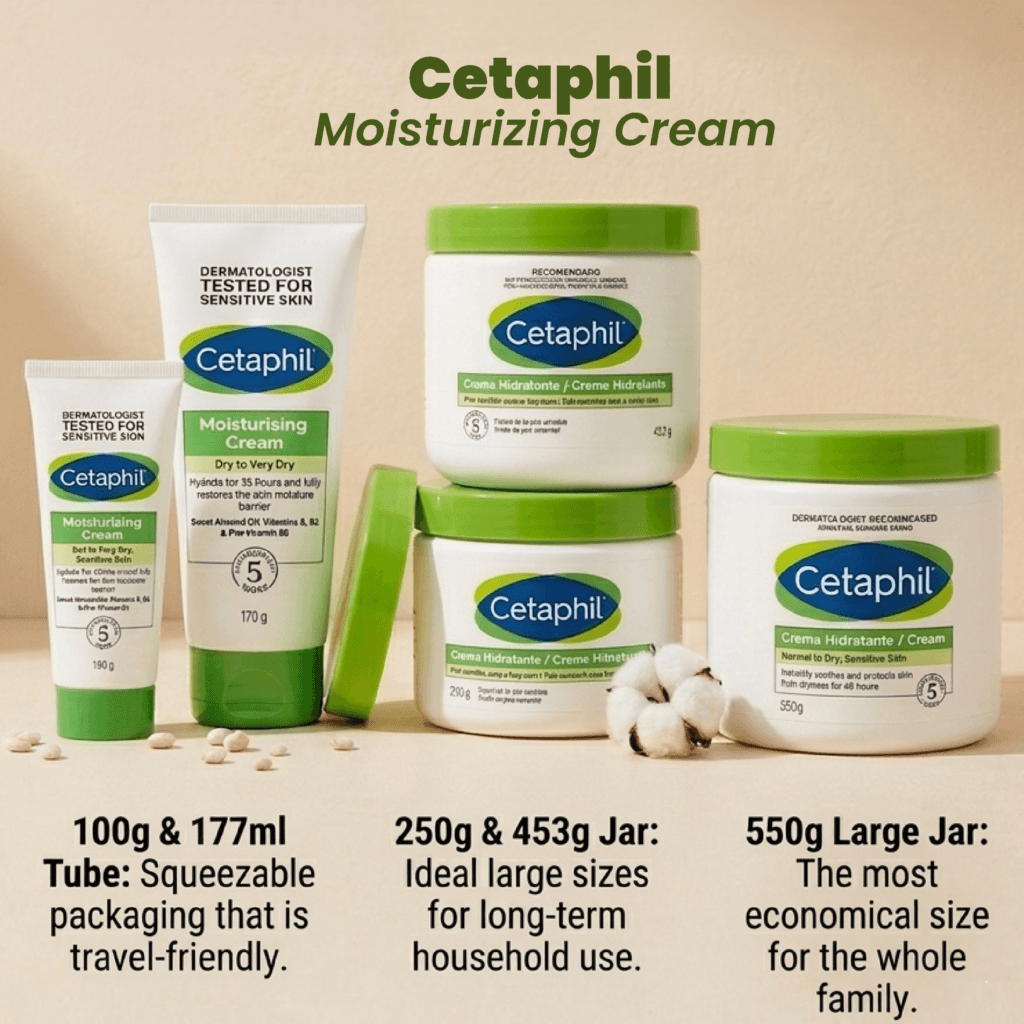
The Ingredients: Where They Really Differ
Both brands are fragrance-free, dermatologist-tested, and non-comedogenic. Those similarities are real and meaningful. But their ingredient philosophies are quite different.
What CeraVe brings to the table
CeraVe’s distinguishing ingredient is ceramides — and it’s not just a marketing claim. Every single CeraVe product contains three essential ceramides, which are lipids that make up about 50% of your skin barrier. When your skin barrier is compromised — from sun damage, aging, harsh products, or conditions like eczema — ceramide levels drop. CeraVe’s formulas are designed to replenish them.
Beyond ceramides, CeraVe uses:
- Hyaluronic acid — draws moisture to the skin surface and helps it stay there
- Niacinamide (Vitamin B3) — calms inflammation, evens tone, improves barrier function
- MVE Technology — a patented delivery system that releases moisturizing ingredients gradually over 24 hours, not just in a single burst
What Cetaphil brings to the table
Cetaphil’s formula is intentionally simpler — which is a feature, not a bug. For skin that reacts to almost everything, fewer ingredients means fewer opportunities for a reaction.
Cetaphil relies on:
- Glycerin — a powerful humectant that draws water into the skin
- Panthenol (Vitamin B5) — soothes irritation and helps the skin retain moisture
- Sweet almond oil — light emollient that adds softness without heaviness
- Petrolatum — creates an occlusive barrier to lock in whatever moisture is already there
“CeraVe repairs. Cetaphil protects. Both hydrate — but they take different roads to get there.”
Head to Head: Six Real-World Tests
1. For dry and very dry skin
This is where CeraVe wins — and it’s not particularly close. The combination of ceramides and hyaluronic acid provides what I’d describe as “deep” hydration rather than surface hydration. I notice a genuine difference in how my skin feels 12 hours after applying CeraVe versus Cetaphil on a dry patch — CeraVe holds moisture noticeably longer.
Cetaphil is still good here, but it works more at the surface level. For moderate dryness, it’s completely adequate. For severe dryness or eczema-prone skin, reach for CeraVe.
Winner: CeraVe wins Ceramides and hyaluronic acid provide deeper, longer-lasting hydration for dry and very dry skin.
2. For very sensitive or reactive skin
This is Cetaphil’s home turf, and it earns it. The minimalist formula means there are simply fewer ingredients that can cause a reaction. Dermatologists have recommended Cetaphil to sensitive skin patients for decades — that’s not an accident.
I have a friend with rosacea who has tried essentially every gentle skincare product on the market. She settled on Cetaphil Gentle Skin Cleanser years ago and nothing has challenged it since. Her skin just doesn’t react.
CeraVe is also very gentle and works well for most sensitive skin types. But the greater number of ingredients does create more opportunities for individual sensitivities — particularly to some of its preservatives.
Winner: Cetaphil wins
Simpler formula means fewer triggers for reactive skin. The go-to recommendation for the most sensitive skin types
3. For oily and acne-prone skin
Both brands make lightweight options for oily skin, so neither has a major advantage in terms of product range. But in terms of formula philosophy, Cetaphil’s lighter touch is generally a better match for oily and acne-prone skin that doesn’t need a lot of barrier repair — it just needs non-comedogenic hydration that won’t sit heavily on the face.
CeraVe is still worth considering here, particularly its PM lotion or the foaming cleanser for oily skin. But if your main concern is staying oil-free and non-breaking-out, Cetaphil is the more intuitive choice.
Winner: Cetaphil edges ahead
Lighter formulas sit better on oily skin and are less likely to feel heavy or pore-clogging.
4. For eczema or compromised skin barrier
CeraVe was essentially designed for this. The National Eczema Association has given its Seal of Acceptance to multiple CeraVe products — and the ceramide-based formula directly addresses the underlying issue in eczema-prone skin, which research has consistently shown to have lower-than-normal ceramide levels.
I went through a period of barrier damage after overusing acids in my routine. My skin was red, tight, and reacting to things it had never reacted to before. Two weeks of nothing but CeraVe Moisturizing Cream helped it recover more noticeably than anything else I tried during that time.
Cetaphil also holds the NEA Seal for some of its products, and it’s not a bad choice here — but CeraVe’s ceramide content gives it a meaningful advantage for barrier-specific concerns.
Winner: CeraVe wins clearly Three essential ceramides directly address the root cause of eczema-prone and barrier-damaged skin.
5. For anti-aging concerns
Neither brand is primarily marketed for anti-aging, and neither contains retinol in their standard moisturizer lines. But CeraVe edges ahead here too — hyaluronic acid is one of the best-studied anti-aging ingredients for skin hydration, and a well-hydrated skin barrier shows fewer fine lines. CeraVe also has a growing line of targeted products including a Vitamin C serum and a Skin Renewing range with peptides.
If anti-aging is your primary concern, you’ll probably want something more targeted than either brand. But as a base moisturizer that doesn’t work against your anti-aging goals, CeraVe has the slight edge.
Winner: CeraVe edges ahead Hyaluronic acid and expanding treatment lineup give CeraVe a small advantage for aging-related concerns.
6. Price and value
Both brands are firmly in the affordable drugstore category. Exact prices vary by retailer and product size, but in general they’re within a few dollars of each other for comparable products. Cetaphil often comes out slightly cheaper per ounce, particularly for their moisturizing cream in larger sizes.
Neither brand will break your budget. The more meaningful consideration is which product actually works for your skin — buying the cheaper one that doesn’t work for you is not good value.
Winner: Cetaphil is marginally cheaper Both are affordable drugstore options, but Cetaphil is often slightly cheaper per ounce for comparable sizes.
Which One Is Right for You?
Stop asking “which is better” — start asking “which is better for my skin.” Here’s a practical guide:
Dry, flaky, or dehydrated skin → Choose CeraVe
The ceramides and hyaluronic acid provide deeper, longer-lasting hydration that surface-level moisturizers can’t match. Start with the Moisturizing Cream or the Hydrating Facial Cleanser.
Very sensitive or reactive skin → Choose Cetaphil
The simpler ingredient list means fewer potential triggers. If your skin reacts to everything, Cetaphil’s minimal approach is your safest starting point.
Oily or acne-prone skin → Choose Cetaphil
Lighter formulas that hydrate without adding heaviness. The Daily Facial Cleanser or the Moisturizing Lotion are good starting points.
Eczema or compromised skin barrier → Choose CeraVe
This is what CeraVe was built for. The ceramide formula directly addresses the underlying issue in compromised skin.
Normal or combination skin → Either works — try both
You’re in the ideal position: both will work reasonably well. CeraVe gives you more ingredient benefits; Cetaphil gives you more simplicity. Try a small size of each and see which your skin prefers.
My Honest Take After Years of Using Both
If I had to put only one in my bathroom, I’d choose CeraVe — specifically the Moisturizing Cream. The ceramide and hyaluronic acid combination is genuinely effective at maintaining and repairing the skin barrier, and I notice a real difference in my skin’s texture and resilience when I use it consistently.
But I wouldn’t throw away my Cetaphil. There are stretches where my skin is irritated or reactive — usually from over-experimenting with actives — and during those times, Cetaphil’s simplicity is exactly what I need. It’s my reset product.
The honest answer most skincare articles don’t want to give you: both are good. The debate between CeraVe and Cetaphil is largely the wrong debate. The right debate is between either of these and whatever you’re currently using that costs four times as much and doesn’t work as well.
“The best skincare routine is one built on boring, effective basics — and both of these brands qualify.”
The Specific Products I Recommend
Both brands have extensive product lines. These are the specific products I’ve used and can personally recommend:
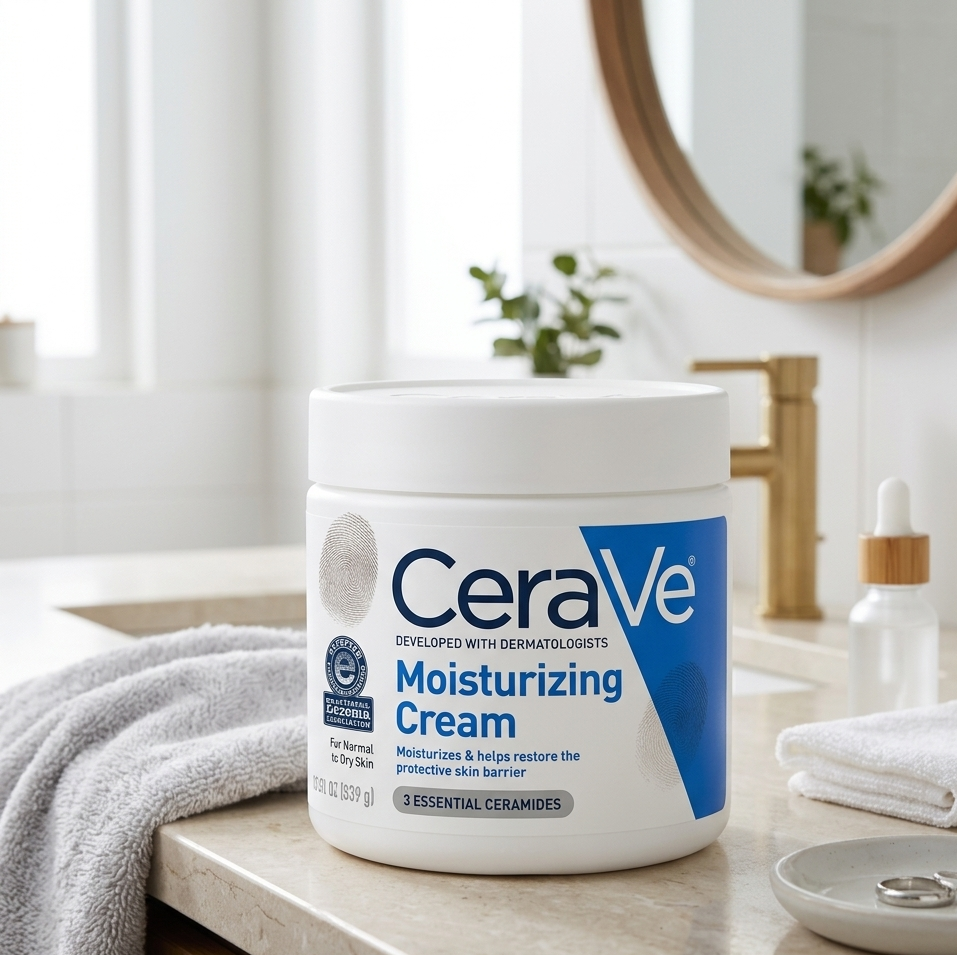
BEAUTY · DRY & NORMAL SKIN · FACE & BODY
CeraVe Moisturizing Cream
Rich, non-greasy cream with 3 essential ceramides, hyaluronic acid, and MVE technology for 24-hour hydration. Suitable for face and body. Fragrance-free, non-comedogenic, and holds the National Eczema Association Seal.
Why I reach for it: This is the product that converted me. Nothing else at this price point has made such a consistent difference to my skin’s texture over time. I go through a tub every 6–8 weeks.
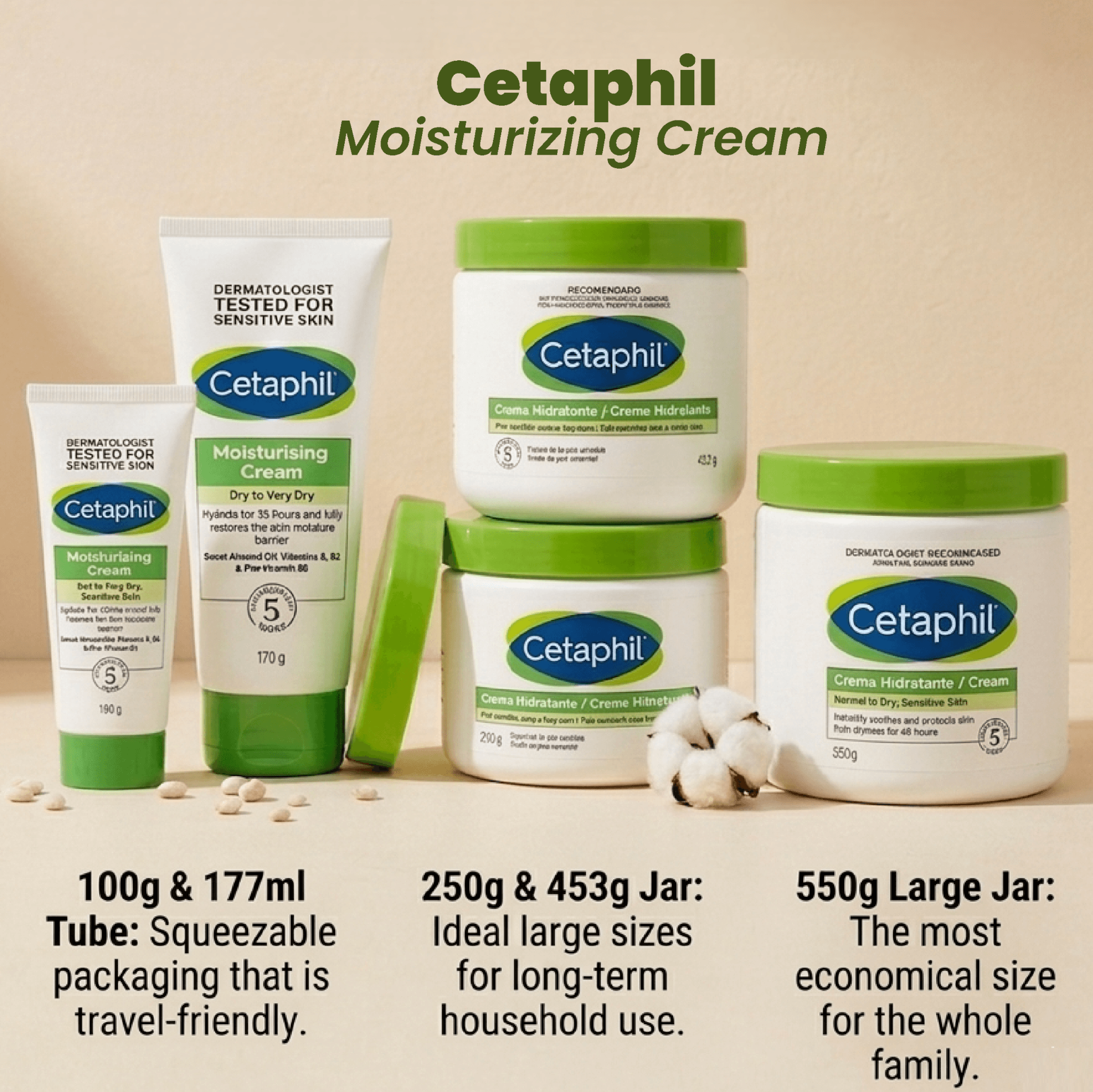
BEAUTY · SENSITIVE & DRY SKIN · FACE & BODY
Cetaphil Moisturizing Cream
Non-greasy, fragrance-free cream enriched with sweet almond oil and vitamin E. Clinically proven to bind water to the skin and prevent moisture loss for 24-hour hydration. Paraben-free and non-comedogenic.
Why I reach for it: My reset product. When my skin is angry about something and I’m not sure what, I strip everything back and use just this for a week. It never causes problems — which is exactly the point.
Frequently Asked Questions
Can I use CeraVe and Cetaphil together?
Yes — and it’s actually a practical approach. Some people use Cetaphil as their cleanser (for its mildness) and CeraVe as their moisturizer (for its barrier-repair benefits). There’s no conflict between the brands or their ingredients.
Which is better for the skin on my body?
Both brands make body moisturizers, and both work well. CeraVe has a slight edge for very dry body skin or conditions like keratosis pilaris. Cetaphil is excellent for general body moisturization, particularly for sensitive skin anywhere on the body.
Are these products safe during pregnancy?
Both brands are generally considered safe during pregnancy — their fragrance-free, minimal-ingredient approach makes them among the better choices. However, always consult your doctor or dermatologist for personal advice during pregnancy.
Why do dermatologists recommend both?
Because both are legitimately good products that work for most people. Dermatologists recommend them because they’re effective, affordable, gentle, and accessible — not because one is objectively better than the other. The specific recommendation usually depends on the individual patient’s skin type and concerns.
Is the more expensive one better?
No. Price correlation with quality is weak in drugstore skincare. Both CeraVe and Cetaphil outperform many products that cost significantly more. If you’re spending a lot on a moisturizer, consider whether you could get equal or better results from either of these.
The Bottom Line
Both CeraVe and Cetaphil are genuinely excellent drugstore skincare brands that earn their dermatologist recommendations. The differences between them are real but not dramatic — and for most skin types, either would be an upgrade over many more expensive alternatives.
Choose CeraVe if your skin is dry, eczema-prone, or has a compromised barrier. The ceramide formula is genuinely differentiated and clinically supported.
Choose Cetaphil if your skin is very sensitive, reactive, or oily and acne-prone. The simpler formula and lighter textures make it the safer, more comfortable choice.
And if you really can’t decide? Buy a small size of each. Both cost under $20. Your skin will tell you which one it prefers far more reliably than any comparison article can.
Have you tried CeraVe, Cetaphil, or both? I’d love to hear what worked (or didn’t) for your skin. Drop a comment below — especially if you have a skin type or concern I didn’t cover. Your experience might help someone else make the right choice.